RFID vs. Barcode: 5 Reasons Your Business Needs an Upgrade
For decades, the barcode has been a reliable soldier in the world of inventory. It brought order to chaos and became the standard for retail and warehouses. But today, in an era of instant deliveries and complex supply chains, this "soldier" is hopelessly outdated.
If you are still spending days counting stock, struggling with mis-sorts, and incurring losses from "unexpected" shortages, this article is for you.
As engineers at Emko Technologies, we deal with the consequences of manual tracking every day. We see businesses losing money, not because they perform poorly, but because they are still using "the old way" to count. It's time to compare the rotary phone (barcode) and the smartphone (RFID).
Why Are Barcodes No Longer Enough?
The barcode is a "one-on-one" technology. It has fundamental limitations that cannot be overcome:
Requires Line-of-Sight: You cannot scan a barcode if you cannot see it. It must be clean, unwrinkled, and facing the scanner.
One-by-One Scanning: To count 1,000 boxes, you must press the scanner's trigger 1,000 times. This takes hours or even days.
Easily Damaged: A paper label is vulnerable to moisture, dirt, and friction. A damaged barcode = an untracked item.
High Human Error: An employee might miss a pallet, scan the same box twice, or simply get tired. The accuracy of a manual count rarely exceeds 90%.
What is RFID and How Does It Work?
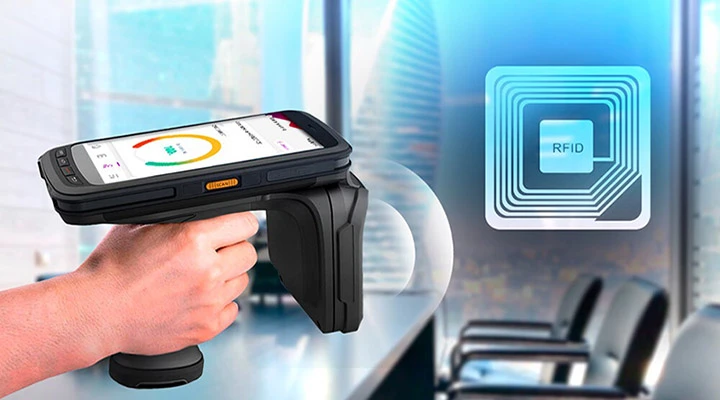
RFID (Radio Frequency Identification) is a technology that uses radio waves to read and write data.
Instead of a paper slip with stripes, you use an RFID tag (a chip with an antenna). This tag has a unique digital "passport."
When an RFID reader (a handheld "gun" or a fixed portal) sends out a radio signal, all tags within its range (up to 15 meters!) "wake up" and simultaneously report their "passports" to the system.
RFID vs. Barcode: A Direct Comparison
Let's look at the facts.
1. Reading Speed
Barcode: One item per second (at best).
RFID: Up to 1,000 items per second. An operator with a handheld RFID reader can complete a warehouse inventory 10-20 times faster than an employee with a barcode scanner.
2. Line-of-Sight Requirement
Barcode: Mandatory. You must "aim" at every label.
RFID: Not required. Radio waves pass through cardboard, plastic, and fabric. You can scan closed boxes without removing them from the pallet.
3. Data Accuracy
Barcode: Depends on the employee. Average accuracy is ~90%. Missed or double-scanned items are common.
RFID: 99.9% accuracy or higher. The system automatically captures every tag. Human error is eliminated. You always know what you have.
4. Durability and Security
Barcode: A paper label. Easily torn, soiled, or faded. Easy to copy (print a duplicate).
RFID: The tag is in a durable housing (plastic, silicone, ABS) or embedded within the item. It is impossible to forge. Anti-metal, heat-resistant, and waterproof tags exist for any condition.
5. Automation Potential
Barcode: Always requires manual labor.
RFID: This is the key to full automation. You can install RFID portals at warehouse gates, and the system will AUTOMATICALLY register every incoming and outgoing item, updating stock levels in your 1C software without human intervention.
When is Upgrading to RFID a Necessity, Not a Luxury?
Many think RFID is "expensive." But in reality, it's more expensive to keep losing money due to manual counting errors.
You need to implement RFID if:
Warehouse inventory takes you more than one business day.
You regularly deal with sorting errors or shortages of high-value goods.
You want to implement an anti-theft (EAS) system at your exits.
You want to see where every asset (like office equipment) is in real-time.
You manage a large number of returnable assets (pallets, containers).
Emko Technologies: Your Partner for the RFID Transition
Switching to RFID isn't just about buying equipment. It's about upgrading a business process.
Emko Technologies provides a full cycle of services for inventory automation in Azerbaijan. We don't just sell "hardware" — we audit your facility, select the right RFID tags and readers, and, most importantly, integrate it all with your software (1C, SAP, Logo) using our own custom-developed software.
Don't wait for the next painful inventory count. Contact us today for a free consultation and a live demonstration of an RFID system at your facility.